The Nairobi Securities Exchange-listed firm said in a regulatory notice on Friday that it has completed the sale of the equity stake it held through Bakki Holdco Limited, a holding vehicle through which the investment group maintained its residual interest in the bank.
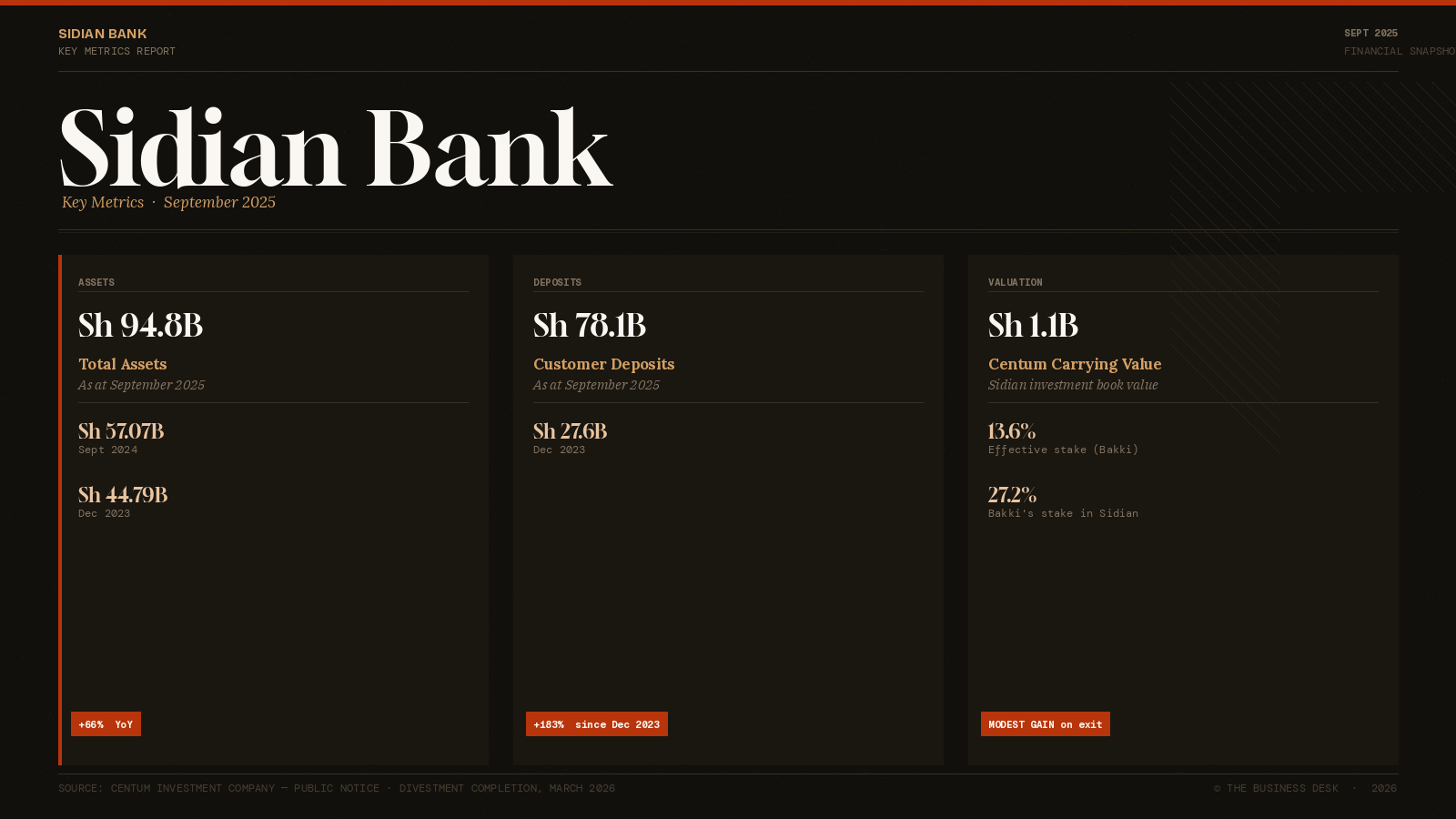
Centum owned a 50 percent stake in Bakki, which in turn held a 27.2 percent stake in Sidian Bank, effectively giving the investment firm a 13.6 percent indirect stake in the lender at the time of the transaction.
This divestment marks the conclusion of Centum’s exit from Sidian Bank Limited. The exit represents an important milestone in Centum’s portfolio management strategy, aimed at strengthening the group’s liquidity position and reallocating capital toward new growth investment opportunities.
— Centum Investment Company, Public Notice
Centum has not disclosed the identity of the buyer or the financial consideration received from the deal. The company indicated only that the financial effects of the transaction will be reflected in its results for the financial year ending March 2026.
“The company expects the sale to result in a modest financial gain relative to the previously reported carrying value of Bakki Holdco Limited in Centum’s books,” the notice stated.
The carrying value of the Sidian Bank investment was Sh1.1 billion at the time of the last published financial statements. Centum chief executive James Mworia had not responded to queries on the buyer or the deal value by the time of publishing.
A Bank on the Rise
The divestment comes at a moment of significant expansion for Sidian Bank. The lender was upgraded to mid-tier status in September last year following a sharp increase in business from large corporate accounts, including government institutions such as Nairobi County and the Social Health Authority. The bank also serves as a receiving agent for Kenya’s housing levy, a role that has channeled substantial deposit flows through its books.
The lender’s total assets climbed to Sh94.8 billion as at September 2025, up sharply from Sh57.07 billion in the same period in 2024 and Sh44.79 billion in December 2023 — a near doubling in under two years. Customer deposits followed a similar trajectory, more than doubling to Sh78.11 billion in September 2025 from Sh27.6 billion in December 2023.
A 25-Year Investment Unravels
The exit closes a chapter that opened in 2001, when Centum first invested in the institution then known as K-Rep Bank. The relationship deepened significantly in November 2014, when Centum acquired a 66 percent shareholding in the bank, lifting its total stake to 67.54 percent and positioning the lender as one of its flagship financial sector investments.
The process of winding down that position began in earnest in 2023 through a series of structured share disposals that brought in a new set of investors. Those include Pioneer General Insurance, which holds a 16.89 percent stake; Wizpro Enterprises at 24.95 percent; Afram Limited at 24.36 percent; Telesec Africa at 3.47 percent; and Pioneer Life Investments at 3.06 percent — all of this prior to the latest transaction.
Centum’s filings show that Bakki held an 81.18 percent stake in Sidian in the financial year ended March 2023. The investment firm disposed of 1.9 million shares the following year, leaving Bakki with a 40 percent interest. That transaction triggered a reclassification of Centum’s investment in Sidian from a subsidiary to an associate in its books. In the same year, Centum, which had previously fully owned Bakki, sold a 50 percent stake in the holding vehicle to a third-party shareholder — a move that further diluted its effective exposure in the bank.
The Deal That Never Was
The drawn-out exit has its roots in a high-profile transaction that ultimately fell apart. Centum had initially agreed to sell its 83.4 percent stake in Sidian to Nigeria’s Access Bank for Sh4.3 billion, a deal first announced in June 2022 that was widely seen as a clean, single-step exit. The transaction collapsed the following year, however, leaving Centum to chart an alternative path.
The failed Access Bank deal forced the investment company to pursue a more complex exit through a sequence of smaller transactions, bringing in a range of new investors and progressively reducing its footprint in the bank over roughly two years. Friday’s announcement marks the end of that long unwind — and the full conclusion of Centum’s presence in Kenya’s banking sector through Sidian.